


The Biggest Sales Navigator Mistake? Building Lists Instead of Building Timing
One of the first things most people do when they open Sales Navigator is build a list.
They choose a geography. Add an industry. Select a job title. Apply a company size. Etc., etc., etc…
Then congratulate themselves because they’ve found 800 people who fit their target audience. There’s nothing wrong with that. But finding the right people is only one part of prospecting.
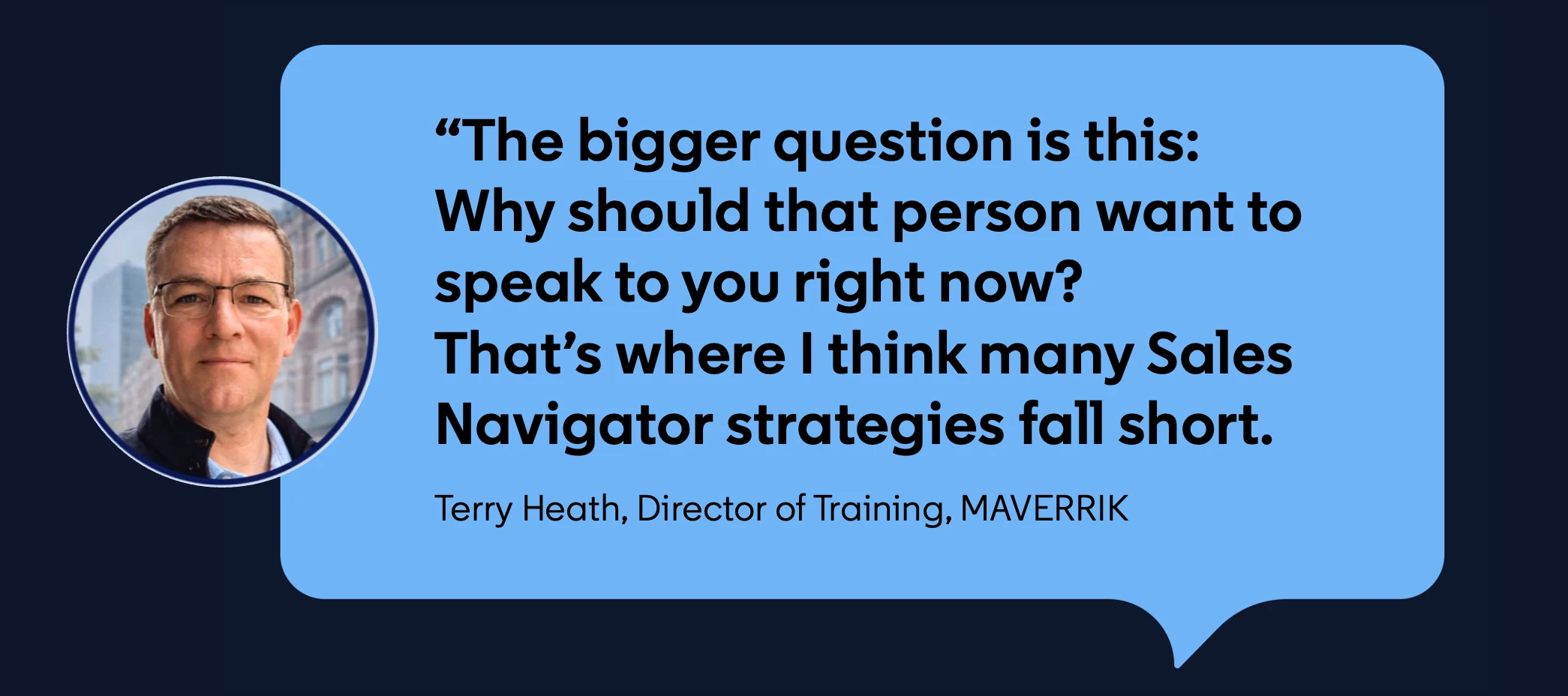
The bigger question is this: Why should that person want to speak to you right now?
That’s where I think many Sales Navigator strategies fall short.
They focus heavily on identifying who to contact, but not enough on identifying when there is a good reason to contact them. And timing can make a huge difference to how your outreach is received.
A good list doesn’t automatically create a good opportunity
Imagine you sell leadership development programmes. You could create a perfectly targeted list of HR Directors working for companies with 500 to 5,000 employees.
Every person on that list might technically fit your ideal customer profile. But that doesn’t mean every one of them currently has a need, a problem or a reason to engage with you.
If you message all of them with the same generic introduction, you’re relying almost entirely on luck.
Right person. Wrong moment.
Sales Navigator becomes much more powerful when you stop looking at it simply as a database and start using it as a system for identifying relevance and timing.
The question I ask isn’t just “Who?”
I tend to think about prospecting through four questions:
1. WHO?
- Is this genuinely someone I want to build a relationship with?
- Do they match the type of person or organisation I can realistically help?
- This is where Sales Navigator search filters, Personas, account lists and lead lists are useful.
- But that’s only the starting point.
2. WHY?
- Why might this person have a reason to care about what I do?
- What challenge, responsibility, priority or objective might make my expertise relevant?
This is where research matters.
Look at the individual. Look at the company. Look at what they’re talking about. Look at what’s happening within the organisation.
You’re trying to find context, not simply contact information.
3. WHEN?
This is the part that is often overlooked.
What has happened that makes now more relevant than three months ago or three months from now?
Perhaps they’ve changed role.
Perhaps the company is expanding.
Perhaps they’ve posted about a challenge you can help solve.
Perhaps there’s been a leadership change.
Perhaps they’re recruiting.
Perhaps Sales Navigator is showing increased activity or intent around your organisation.
These signals don’t necessarily mean someone is ready to buy. They do, however, give you a reason to pay attention.
4. HOW?
Once you’ve found the right person and a reason why the timing might be relevant, the final question becomes:
- How should I approach them?
And the answer isn’t always, “Send them a message.”
Sometimes the best next step is to follow them.
Sometimes it’s to engage with something they’ve posted.
Sometimes it’s to connect.
Sometimes there’s enough context to start a direct conversation.
The important point is that your action should reflect the situation.
Lists should be the beginning, not the end
I regularly see people spend hours creating highly detailed lead lists.
Then the next step is: “Right, now let’s message everybody.”
That misses much of the value Sales Navigator can provide.
Once I’ve created a relevant group of people, I want Sales Navigator to help me monitor them.
Who has changed jobs?
Who has become active?
Which accounts are showing signs of change?
Who is posting?
Who has appeared in the news?
What is happening inside the organisations I care about?
This is why saved leads and saved accounts can be far more useful than a one-off search.
The objective isn’t simply to create a static database. It’s to create a group of people and organisations that you can observe over time.
Think signals, not just searches
Sales Navigator gives us more signals than many sellers ever use. And those signals can create far better starting points for conversations.
A new role, for example, gives you a legitimate reason to congratulate someone and understand their new priorities. An account growing rapidly might suggest new challenges are emerging. A prospect posting regularly allows you to understand what they care about before you ever contact them. An alert might remind you of someone you added to a list six months ago but didn’t have a good reason to approach at the time.
None of these signals guarantees an opportunity. That’s not the point.
The value is that they help you decide where your attention should go today.
This also changes how you think about volume
A common question I get is: “How many prospects should I have in my list?”
I think there’s a better question. How many relevant people can you realistically pay attention to?
Finding 2,000 prospects is easy. Building awareness around 50 or 100 high-value prospects is much harder, but potentially far more useful.
Because the objective shouldn’t be to contact as many people as possible. It should be to recognise the people where relevance, need and timing start to come together.
Sales Navigator works best when you use it as a radar
I often describe Sales Navigator as a radar. You decide which people and companies you want on the radar.
Then you use the information and signals around them to decide where to focus.
Some people will remain quiet. Some won’t be relevant right now. Others will suddenly give you a reason to pay attention.
That’s when the value of Sales Navigator becomes much clearer. You’re no longer opening the platform every morning wondering: “Who can I message today?”
Instead, you’re asking: “What has changed, who should I pay attention to, and where is there a genuine reason to start a conversation?”
That is a very different approach to prospecting. And in my experience, it leads to much better conversations.
Because a good prospecting strategy isn’t only about finding the right people. It’s about recognising the right moment to engage them.